Desalination is actually a crucial technologies for providing fresh new drinking water in many aspects of the earth, nevertheless it comes along with its personal list of advantages and drawbacks. Here is a breakdown:
Benefits of Desalination:
1. Responsible Drinking water Resource: It provides a dependable and trustworthy supply of refreshing h2o, independent of rainfall or area water resources.
two. Drought Resilience: Desalination is invaluable in drought-prone spots, making certain a ongoing water offer even throughout critical droughts.
3. Water Stability: It enhances drinking water protection for locations depending on h2o imports or People with confined freshwater sources.
four. Supports Agriculture and Field: By supplying clean drinking water, desalination supports agriculture and business in arid areas, contributing to economic security and advancement.
five. Ecosystem Conservation: By supplementing all-natural water sources, it lowers the necessity to extract h2o from delicate ecosystems, assisting to protect biodiversity.
six. Technological Innovation: Desalination drives progress in h2o treatment engineering, which could gain other parts of drinking water management and conservation.
7. Scalability and Flexibility: Desalination plants may be scaled to fit the requirements of tiny communities or huge towns, and they are often Situated close to coastal places in which the need for fresh h2o is frequently best.
Down sides of Desalination:
1. Superior Electricity Intake: Standard desalination processes, significantly reverse osmosis and thermal distillation, are Electricity-intensive, leading to significant operational charges and prospective environmental impacts.
two. Environmental Affect: The discharge of very concentrated brine again to the ocean can harm maritime ecosystems. Also, the intake course of action could be unsafe to marine lifetime.
3. Price tag: The Preliminary set up and ongoing operational fees of desalination vegetation are significant, building the water generated more expensive than that from regular sources.
4. Carbon Footprint: Until powered by renewable Strength resources, desalination plants lead to greenhouse gasoline emissions because of their large Electricity consumption.
5. Infrastructure and Servicing: Desalination crops involve complex infrastructure and normal maintenance, that may be demanding in distant or less produced parts.
six. Restricted to Coastal Regions: Most desalination plants are viable only around sea coasts, restricting their applicability for landlocked areas Until high priced transportation is concerned.
7. Probable for Air pollution: Without the need of proper management, the method can deliver harmful chemical byproducts, contributing to air pollution.
Balancing the Scales:
The decision to implement desalination usually comes all the way down to a stability involving the urgent have to have for refreshing water as well as the prospective environmental and economic expenses. In several locations, the benefits of having a responsible h2o provide outweigh the drawbacks, especially as technologies advances and results in being far more effective and eco-friendly. For Some others, the large prices and environmental concerns enable it to be a a lot less viable possibility. As such, It is really typically part of a broader tactic that includes drinking water conservation, recycling, and the use of different h2o sources.
Desalination, even though often talked about in terms of its issues and environmental impacts, also provides a number of environmental Added benefits, especially in areas struggling with serious drinking water scarcity. Here is how desalination is usually advantageous on the ecosystem:
1. Offers a Reputable H2o Resource:
- Desalination features a steady, climate-independent source of water. This is especially vital in arid areas the place regular resources are inadequate or non-existent, cutting down the pressure on overused rivers, lakes, and underground aquifers.
two. Supports Ecosystems and Agriculture:
- By giving an alternate source of clean drinking water, Desalination Plant Manufacturer desalination can assist protect normal freshwater ecosystems That may in any other case be depleted for human use. Furthermore, it supports agriculture in arid areas, marketing foods security and decreasing the necessity to divert h2o from sensitive ecosystems.
three. Cuts down About-Extraction of Freshwater:
- In lots of elements of the planet, the demand from customers for freshwater causes the about-extraction of rivers and groundwater, triggering environmental harm like habitat decline and land subsidence. Desalination can lower this strain by supplementing the freshwater supply.
four. Possible for Renewable Energy Integration:
- Modern-day desalination plants are increasingly working with renewable Vitality resources, including photo voltaic or wind electricity. This not only lessens the carbon footprint of desalination but additionally encourages The expansion of renewable Vitality infrastructure, contributing to the broader environmental reward.
five. Encourages Water Recycling and Innovation:
- The entire process of desalination encourages technological innovation in h2o management. A lot of crops are made to recycle and reuse drinking water throughout the plant, leading to far more economical water use Total. Innovations in desalination engineering generally spill over into other areas of drinking water management, advertising and marketing conservation and efficient use in numerous sectors.
6. Enhances Human Overall health and Enhancement:
- While not a direct environmental advantage, offering reputable use of cleanse h2o increases general public wellbeing and socioeconomic enhancement. Much healthier populations with secure livelihoods are improved Geared up to control and treatment for their organic sources, leading to much better environmental stewardship.
seven. Drought Resilience:
- Desalination presents locations at risk of droughts that has a regular drinking water supply, mitigating the impacts of drought on human populations and the environment. This helps reduce the overuse of scarce pure drinking water throughout drought durations, preserving ecosystems and wildlife.
eight. Possible for Brine Utilization:
- Research is ongoing into tips on how to make use of the byproduct brine, including in salt extraction, aquaculture, or at the same time as a raw material for sure industries. Using brine can help mitigate its environmental impression and turn a squander solution right into a resource.
Summary:
While desalination does pose environmental worries, specifically related to Electricity use and brine disposal, its Advantages in giving a stable, reputable supply of refreshing h2o can add positively to environmental sustainability, especially when coupled with renewable Electrical power and progressive systems. As technology improvements as well as efficiency of desalination improves, its position in environmental administration and h2o sustainability proceeds to develop.
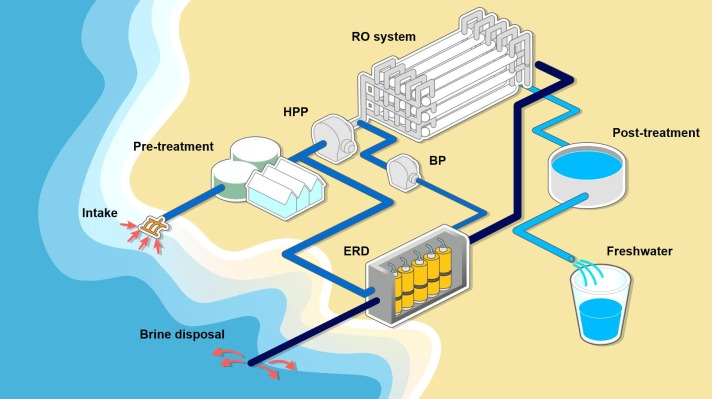
Desalination is the entire process of taking away salt and other minerals from saline water to supply contemporary h2o which is well suited for human use, irrigation, as well as other makes use of. Here is how it normally performs:
one. Consumption:
Saltwater, normally through the ocean or briny groundwater, is taken in the desalination plant.
2. Pre-treatment method:
The consumption water is pre-handled to remove particles and sediments. This step might contain filtration as well as addition of substances to forestall the growth of organisms that might foul the program.
3. Desalination (Most important System):
There are 2 Major techniques used:
- Reverse Osmosis (RO):
- The pre-addressed drinking water is forced as a result of semi-permeable membranes underneath large pressure.
- The membranes allow for drinking water molecules to pass through but block salt and various impurities.
- This process requires major Vitality, mainly to build the stress required to drive h2o with the membranes.
- Thermal Distillation:
- Solutions like Multi-Stage Flash (MSF) or Multi-Influence Distillation (MED) involve heating the saltwater.
- The drinking water evaporates, leaving the salts at the rear of, then the vapor is condensed to form clean h2o.
- These strategies will often be used in areas wherever Power, specially from squander warmth or fossil fuels, is relatively economical.
four. Post-remedy:
- The desalinated drinking water is likely to be remineralized or have its pH adjusted to make it ideal for its meant use.
- Minerals could possibly be included again to make the water taste far better and to satisfy overall health benchmarks for ingesting h2o.
five. Brine Disposal:
- The leftover brine (remarkably concentrated saltwater) and various squander products and solutions must be cautiously disposed of, usually by returning it to the sea. Proper disposal is crucial to attenuate environmental effects, given that the superior salt focus can damage marine ecosystems.
Energy and Environmental Criteria:
- Desalination is Electrical power-intense, specifically reverse osmosis. Attempts to make the procedure additional productive and environmentally sustainable consist of using renewable Electrical power sources and enhancing membrane technology to have to have considerably less stress and Electrical power.
- Environmental issues also contain the impact of brine disposal on marine life plus the carbon footprint from the Electricity sources applied.
Desalination is surely an significantly essential technological know-how, especially in parts exactly where clean h2o is scarce. Developments in know-how and Power effectiveness are rendering it a far more practical option for offering fresh new h2o to populations around the globe.